Action dossier
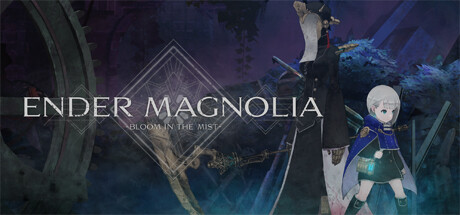
ENDER MAGNOLIA: Bloom in the Mist
- Vibe
- Homunculi, fumes, and a sharper sequel-language action RPG
- Playtime
- 15-25 hours
- Difficulty
- Medium-high
- Store
- Steam
The Hook & Core Philosophy
ENDER MAGNOLIA is Live Wire's return to the rain-and-ruin family, now in the Land of Fumes with Lilac, an Attuner who can save or at least walk beside homunculi that industry and poison drove mad. It is a 2D action RPG sequel-in-spirit: more mechanical toys, more vertical production, the same refusal to turn sadness into a joke. Japanese players treated it as a prestige follow-up, the test of whether Ender Lilies was a one-time aesthetic hit. You explore a stratified kingdom of labs, factories, and academies, fight feral creations, and build a team of homunculi skills that feel like a party living in your shortcut bar. Overseas, it is the rare Japanese indie sequel that arrived with expectations. This dossier exists to say it is still an action game first, a lore wiki second, and a language exam almost not at all if you use English.
Mechanical Architecture & Game Loop
The attunement fantasy is the system: you are not only collecting bosses as guns, you are negotiating a world where the weapons are people-shaped. That could have been flavor. Live Wire ties it to combat roles so that a homunculus is a kit and a story object. Map design is more industrial and architectural than Lilies' ruined pastoral, which changes exploration rhythm: machines, fumes, vertical shafts, classrooms that are also dungeons. Difficulty still lives in boss literacy and build choice, not in untranslated menus. Quality-of-life is what a 2020s Japanese action RPG is willing to give players who already finished the first game. Compared with Ladybug titles, Magnolia is heavier and more RPG. Compared with a full JRPG, it still respects your time by keeping conversations skippable and arenas decisive. Japanese discussion splits between mechanical sequel talk and thematic talk about who gets saved. Overseas players can join the mechanical talk immediately. The thematic talk needs a language they can read, which Steam provides. If you bounced off Lilies for being too slow, Magnolia is the argument that the studio heard you without becoming a character-action game.
Community Reception & Japanese Player Consensus
- Sequel pressure on a national indie hit. Lilies was a point of pride. Magnolia's launch and updates were treated as a domestic prestige event, which keeps review volume and stream numbers high.
- Homunculi as a more JRPG party. Japanese action-RPG fans latched onto the team-of-skills fantasy. Build posts are the sequel's social layer.
- Production values as a statement. Players point at the factories and music as proof the studio scaled up without leaving Japan. That narrative is catnip in Steam recommendation threads.
Radar Verdict & Steam Accessibility
Ender Lilies players, Metroidvania-RPG fans, people who want Japanese dark fantasy without a 60-hour JRPG calendar. Skip if 2D action bosses make you miserable.
Language barrier
Low (Basic UI/Menu)
English is supported. Combat, attunement, and map verbs are visual. Lore is denser than Lilies; skipping text costs world-understanding, not the next boss door. Japanese players will argue about homunculi politics in Japanese. You do not need that argument to play. UI is modern. This is Low, with a lore-optional Medium if you care about every laboratory log.
Playtime and difficulty
Fifteen to twenty-five hours is a fair first-campaign window depending on side rooms. Medium-high bosses. More systems than Lilies, still finite. Wait for patches if you are allergic to day-one jank; the design intent is a complete action RPG, not a live-service.