Adventure dossier
Lost Ruins
- Vibe
- Deliberate and Deadly Gothic-Anime Survival Platformer
- Playtime
- A standard playthrough takes about 6 to 8 hours,
- Difficulty
- A standard playthrough takes about 6 to 8 hours,
- Store
- Steam
The Hook & Core Philosophy
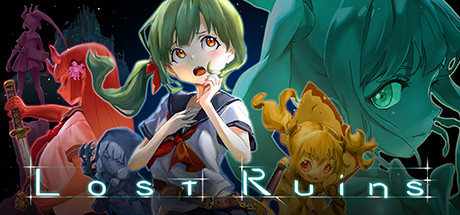
Lost Ruins is a 2D side-scrolling action-survival game that tasks a schoolgirl, stripped of her memories, with exploring a hostile subterranean realm. While structurally resembling a Metroidvania, it downplays mobility-based progression like double jumps and dashes, focusing instead on tight tactical encounters. Combat requires utilizing an expansive arsenal of melee weapons, ranged bows, and environmental magic. Players must manage physical assets in a world where recovery is scarce; campfires do not restore health, forcing reliance on found items and merchant trades. Strategic use of the environment is highly encouraged, allowing players to electrocute enemies standing in water or set oil slicks ablaze. While visual presentation features highly detailed, fluidly animated pixel-art characters, the core design prioritizes methodical survival and high-risk encounters. True progress depends on system exploitation, learning enemy tells, and mastering a generous dodge roll that offsets the protagonist's low overall mobility.
Mechanical Architecture & Game Loop
Lost Ruins stands apart by rejecting the power-fantasy pacing typical of contemporary 2D action games. The protagonist feels deliberately heavy; mid-air attacks cancel forward momentum, dropping her straight down, and weapon swings possess distinct startup frames that demand commitment. Furthermore, the game features no invincibility frames upon taking damage. If caught in a multi-hit trap or cornered by an aggressive enemy combo, your health bar can disintegrate instantly. This lack of a post-hit safety net forces a paradigm shift: defensive play is not just optimal, but mandatory. To survive, players must exploit environmental interactions. Pouring poison into water basins, igniting puddles of oil, or casting electric spells on wet ground can clear entire rooms without risking direct melee exposure. The game's economy is equally severe. Because save points do not replenish health or mana, resources are incredibly scarce during the early game. However, this creates a compelling power curve: once you discover powerful equipment configurations (like elemental resistance gear and health-leeching spells), the game transforms into an incredibly satisfying power trip where you can completely break the initial mechanical limitations.
Community Reception & Japanese Player Consensus
- High-Quality Pixel Art and Character Design. Japanese players have expressed immense admiration for the detailed, fluidly animated sprite work and expressive character designs. The juxtaposition of a cute, uniform-clad schoolgirl navigating a grimly detailed dark fantasy setting appeals heavily to fans of subgenres like 'ryona' (the aesthetic of cute characters enduring harsh trials) and classic doujin platformers like Momodora.
- Unapologetically Uncompromising Survival Elements. The domestic community was deeply engaged by the lack of comfortable modern features, specifically the decision not to heal players at save points. Japanese reviews frequently highlight how this friction demands an old-school, resourceful approach to dungeon crawling, turning every healing potion and copper coin into a vital tactical choice during the brutal early hours.
- Strategic Combat Over Raw Reflexes. Rather than testing twitch reflexes, the game rewards situational awareness and environmental manipulation. Players widely discussed the cleverness of using elemental interactions—like using water as a conductor for lightning spells—enabling players who struggle with high-speed action to outsmart boss encounters using customized equipment loads and preparation.
Radar Verdict & Steam Accessibility
Buy this if you love atmospheric, methodical 2D action games like Momodora, appreciate high-quality pixel art with a touch of dark-anime aesthetics, and enjoy planning combat encounters using environmental traps and elemental weaknesses. Skip this if you expect a fast-paced, high-mobility Metroidvania with double-jumping, air-dashing, and instant-response combat.
Language barrier
Low (Basic UI/Menu)
The game features robust official Japanese and English localization. Non-Japanese speakers will have no trouble navigating menus, managing inventory items, or understanding weapon attributes. Progression is highly visual, and the map layout is relatively straightforward.
Playtime and difficulty
A standard playthrough takes about 6 to 8 hours, while chasing multiple endings or tackling the 'Boss Mode' can push playtime past 12 hours. The difficulty is steep at the start due to low health and high penalty for mistakes, but it plateaus significantly in the late-game once powerful spell combinations are acquired.