JRPG dossier
Recettear: An Item Shop's Tale
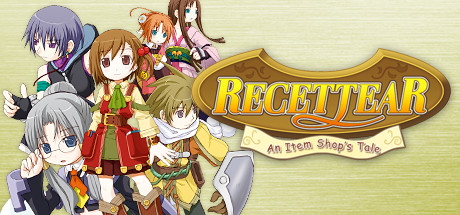
- Vibe
- Cozy debt-driven item shop JRPG
- Playtime
- 15-25 hours
- Difficulty
- Medium (the calendar is the boss)
- Store
- Steam
The Hook & Core Philosophy
Recettear is EasyGameStation's shop-sim JRPG about Recette, a girl who must pay back her missing father's debt under the supervision of Tear, a fairy loan shark with a spreadsheet for a heart. By day you set prices, rearrange the shop, and read customer tells. In adventure segments you hire heroes, run randomized dungeons, and feed the shop with loot. The joke is capitalism with a cute face; the system is a weekly payment calendar that will evict you if you play like a completionist tourist. Haggling is a mini-game of portraits and percentages. Dungeons are modest action-RPG slices, not the main meal. Japanese players still recommend it as the ancestor of every I-run-a-shop-in-another-world fantasy, years before that was an isekai default. On Steam it is also a historical artifact of the late-2000s English indie localization boom: the script is funny on purpose, not as a machine-translation accident.
Mechanical Architecture & Game Loop
The calendar is the difficulty slider. Every payment deadline forces a portfolio decision: discount to move volume, hold a rare item for a whale customer, or dive a dungeon tonight and risk fatigue. Customers have budgets and taste tags; overpricing a regular is a relationship mistake, not only a math mistake. That social-economy loop is why Japanese management-game fans still write essays about Recettear while many Western players remember the puns. Dungeon crawling exists to inject variance into the shop. A failed run is a cash-flow crisis. Heroes have different loot tables and fight styles, so choosing an adventurer is choosing a supply chain. Shop furniture and display are light customization with real-enough effects on customer flow. Compared with modern tycoon games, Recettear is small and authored. Compared with JRPGs, it is rude about your time. The brilliance is that Tear's cruelty is the tutorial: the game tells you the number you must hit and then lets you embarrass yourself with kindness by underpricing or greed with an empty shop. New Game and post deadlines extend the loop without needing an open world.
Community Reception & Japanese Player Consensus
- It pre-wrote the isekai shop fantasy. Japanese recommendation threads still point at Recettear when a new merchant-in-another-world anime or game drops. It is treated as the mechanical original, not a clone of a 2020s trend.
- Debt as a game feel. Players love and hate the payment week as a uniquely stressful cozy game. Screenshots of Tear's warnings are a meme format that resurfaces whenever someone asks for cute but actually hard.
- Carpe Fulgur's English made it a two-way classic. Japanese users are proud that a doujin-scale RPG became a Western cult game without losing its voice. It gets recommended as proof that Japanese indie writing can travel if the localization is treated as craft.
Radar Verdict & Steam Accessibility
People who like shop sims, light dungeon crawling, and comedy JRPGs. Perfect if you want Japanese indie history with a full English script. Avoid if you hate timers, capitalism jokes, or talking to customers.
Language barrier
Medium (Screen Translation OK)
The official Steam localization by Carpe Fulgur is famous; play in English and the barrier is None. The original Japanese is text-heavy: haggling, customer personality, item names, and quest chatter. Without English, a screen translator on the shop UI can get you through pricing, but you will misread customer tastes and story beats. This is the opposite of Downwell. On the actual Steam SKU, choose English and enjoy one of the best Japanese-to-English indie localizations ever shipped.
Playtime and difficulty
A first successful debt clearance is often 15-20 hours if you learn haggling. Failure loops add time. Dungeon combat is modest; the real difficulty is planning. Not a twitch game. Spreadsheet-brained players have an edge.